
“It’s going to be OK tomorrow.” 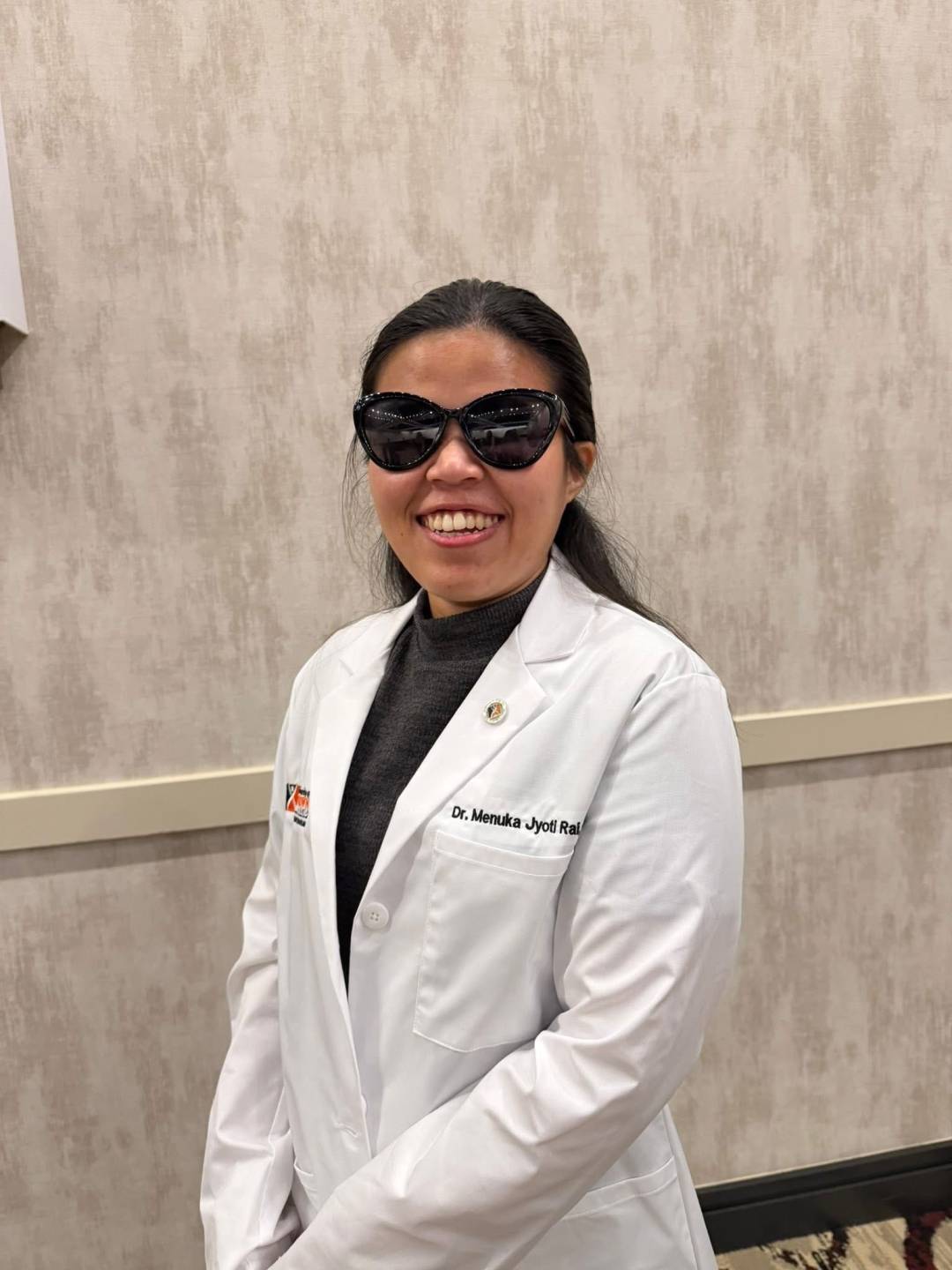
“You have to know how much is in you.”
These were two of the mantras that Menuka “Jyoti” Rai repeated to herself while pursuing her doctorate in physical therapy through the University of Jamestown over the last 3 years. After graduating in May, Menuka is actively looking for a job while reflecting on how she got here, pursuing her dream career as a physical therapist. Ever since she was a little girl, Menuka has wanted to work in medicine. She spent much of her childhood in a refugee camp in Nepal. “I lost a lot of family members and neighbors there. I myself faced a lot of health problems,” she explains. At the age of 6, Menuka was diagnosed with retinoblastoma and subsequently lost all of her vision. But her blindness never diminished her goal of working in healthcare. “In high school, after I moved here [to Grand Forks, North Dakota], we went on a tour of Northland Community and Technical College. That’s when I learned about physical therapy. What was really appealing was that you can help people without medications or performing surgeries,” she says, both of which would be complicated with no vision. “I can contribute to the healthcare field but do it without equipment. PT is mostly knowledge and skill.” And – she has learned – a lot of hard work.
Building Knowledge and Skill
There were about 30 students in Menuka’s cohort for her physical therapy program. Her classmates, she says, were helpful and supportive of each other. “In 3 years, you get to really know the people. You’re with them for 8 hours, 5 days a week.” The program was intense, and, naturally, she was held to the same expectations her classmates were. It didn't matter that she was blind. When the class was watching videos or a demonstration was being performed, a TA or extra faculty member would describe the actions. The process of hearing the descriptions and her asking clarifying questions in order to get even more accurate information helped her improve her relationship with her patients, she believes. When she went on her clinicals, she knew the types of questions to ask patients in order to get them to more fully describe their ailments and discomfort.
Menuka spent 30 weeks in total at 4 different clinics on her clinicals. “I had very wonderful Clinical Instructors,” Menuka says. “You do a lot of learning in the classroom, but the actual patient care you learn most in the clinic. You’re using the knowledge from the classroom in the clinic.” Like her classmates, her Clinical Instructors (CIs) were incredibly supportive of her. “They made sure that the patients knew that they trusted me. They showed they were confident in me; that helped me a lot,” she says.
Having a blind student was a new experience for all the practicing physical therapists that she worked with. One of the accommodations for her clinical experiences was that she was able to visit the clinic and meet her CI ahead of time; other students had to wait until their first day to step foot onto their site. Besides getting oriented to the location, this early exposure to the clinic and her CI ensured that “I could answer any questions they may have and ask mine” Menuka explains. “This was helpful for them, and for me.”
Menuka says there were very few instances where her blindness became an issue for the patients she encountered. And she is understanding that it would be. If an individual has never worked with someone who is blind, it’s “reasonable,” she says, that they’d be concerned about their care. In PT, a patient is “entrusting their safety, not just their health,” to the doctor, she explains. In these cases, “my CI would take the lead, and I’d try my best to establish that relationship even though I was on the sideline.” Having conversations here and there, she’d “keep building that trust and eventually they’d be comfortable working with me too,” she says. It was these relationships with her patients, “that alliance,” she says, that was the most rewarding part of her clinical experiences. “That was truly a blessing.”
On her clinicals, PT aides in the clinic were able to help "be her eyes" if they were available. Like the faculty members who described videos and demonstrations in the classrooms, the aides were able to tell her if a patient was limping, to explain how equipment was set up in the room, or to read the questionnaire the patient filled out in the waiting room. She also used some accessible healthcare devices, including a talking blood pressure checker and talking oximeter, and also some accessible apps to help her read or take notes. But because of HIPAA, not all available technology can be utilized in a clinic setting.
Persistence and Support
Anyone going through a doctoral program for physical therapy would deem it demanding, but “being blind brings a host of other challenges,” Menuka explains. While assistive technology has come a long way, it is not always reliable. “It’s great when it’s working but sometimes it doesn’t. That frustration – you have to work through it,” she says. “An assignment that takes 15-20 minutes for a sighted person could take you an hour.” But persistence, she says, is key. “The challenges are endless, whether you’re going through life in general or in a program like this!” she says. “You get frustrated many times. You have to be really persistent with that goal.” And, she says, patient with yourself. “It just takes time, and everything is reachable. There are so many things that make you want to quit, but what’s hard doesn’t kill you.” Those mantras – It’s going to be OK tomorrow. You have to know how much is in you. – also provided strength.
She was also grateful for the support of NDVS/SB, who the University of Jamestown turned to throughout the 3 years for assistance. “I think NDVS/SB was a great resource at the beginning. They helped the program determine what was needed and produced tactile graphics and suggested how equipment could be modified,” she says. Knowing that NDVS/SB was there to help was also “comforting to me too, knowing that if I needed something, NDVS/SB would be there. I am the consumer so I don’t always know what exactly I need. NDVS/SB can help determine that.”
Other agencies, including Vocational Rehabilitation (VR), have also been also great resources for Menuka. VR helped pay for some of the accessible technology, and they are currently helping her find employment. This support is reassuring to Menuka. “Being blind,” she says, “not all employers feel the most confident with me,” but her VR counselor is helping her ease those fears, with ideas like creating a video resume so that potential employers can see her skills, and encouraging her to reach out to other blind PTs for their advice.
Finding Confidence and Success
Because the University of Jamestown’s Doctor of Physical Therapy program is located in Fargo, Menuka moved to Fargo from Grand Forks, where she had attended high school and graduated from the University of North Dakota. Living on her own for the first time was a new experience, not to mention getting to know a new community and how to get around and travel safely within that community. This is where her time attending short-term programs at NDVS/SB as a high schooler came in handy. “Every time I vacuum, I think of NDVS/SB. The grid pattern!” she laughs. “And baking – every time I bake brownies I think of [Daily Living Skills instructor] Ken Dockter. Those skills, if you’re living by yourself, there’s no one to do it for you.” When she first moved into her apartment in Fargo, a staff person from NDVS/SB helped her label her appliances and learn her route so she could walk to and from the building where her classes were held. The confidence that independence brings is so important, as is the ability to ask for help, another skill she says she learned at NDVS/SB. “We were always encouraged to ask for help if we needed it,” she says.
Someday, Menuka hopes to return to the refugee camp where she spent her childhood so that she can serve that community. In the refugee camp she lived in, she says, there are healthcare facilities for when you’re sick, but “there’s nobody to help you get back on your feet, for example after having a stroke. Or, if children are born with some kind of congenital issue, people accept it as a lifelong ailment. But through my program, I’ve seen so many children improving and meeting their milestones.” It’s this dream – that someday she can help children who, like her, are growing up in that camp – that has given her life its mission, its vision. “I would encourage students to pursue any career that you want – I would just say dream big. Anything demands hard work but don’t be afraid to dream just because of your visual impairment or blindness. There will be people who say you can’t do it, but there are also people – your support system – that you can tap into. They will be behind you and support you.” Menuka feels incredibly grateful for her own support system. “I’m thankful to everyone who supported me to get this far including family, friends, teachers, and all the agencies,” she says.
Now, as Menuka pursues her dream, she is hoping the next step of finding the right job happens quickly. “I hope the employers are open-minded and don’t make assumptions,” she says. “I hope that when they sit down with a blind candidate, they are treating them just as a sighted person. Of course they can ask about accommodations and be curious about how they do things. But don’t think they aren’t a good candidate just because of their visual impairment.” Knowledge, skill, hard work, and persistence – those are the things that make a good candidate, that inspire success. In this case, Menuka’s success is guaranteed.