
News
Categories: All News Items, Superintendent
 by Paul Olson, NDVS/SB Superintendent
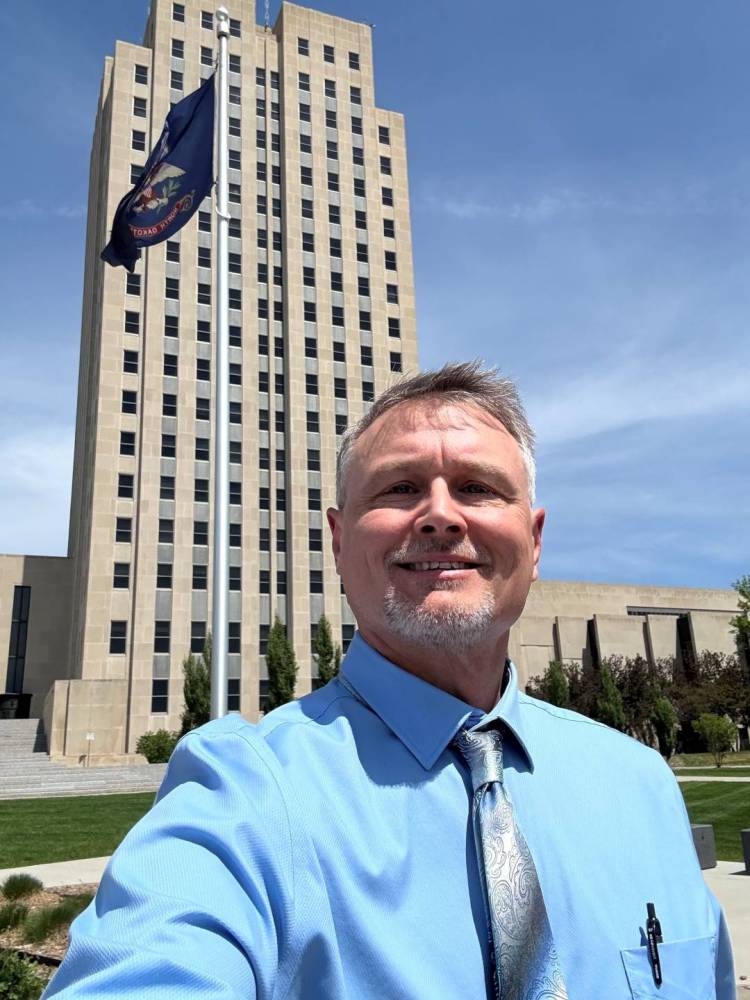
As the Superintendent of NDVS/SB, I visit the legislature every other year to testify in regard to our agency budget request. I always enjoy telling our story as part of that process. It is our opportunity to go on record about needs in the state as well as our successes and challenges. Over the years I have had a few opportunities to testify about specific questions that have come up in the interim. I was recently asked to provide testimony at the Capitol on May 27th to the Health & Human Services Committee made up of members of the North Dakota Senate and the House. This Committee had formally inquired about vision screening practices for infants. This question arose as an off shoot of an interim study regarding screening practices for children that might be deaf and hard of hearing. In addition to this topic, the committee asked me to address how citizens of the state with low vision and blindness experience state government in general.
Categories: All News Items, Instruction, Student Programming
by Cindy Williams, TSVI, Coordinator of Student Programs
As another successful school year comes to a close, we celebrate the growth, accomplishments, and perseverance of our students and families. While summer brings opportunities for recreation and sunshine, it also provides the opportunity for students who are blind or have low vision to continue building important life skills beyond the classroom. Summer experiences can support growth in areas of the Expanded Core Curriculum (ECC), including independent living, assistive technology, self-determination, and community readiness. These essential skills help students gain greater confidence, independence, and access to both their education and everyday environments. Throughout the summer months, many national organizations offer engaging programs, resources, and activities that families can incorporate at home to encourage continued learning and skill development.
Categories: All News Items
by Tracy Wicken, Assistive Technology Specialist
After 41 years of working for the State of North Dakota, 21 of which working for ND Vision Services/School for the Blind as an Assistive Technology Specialist and Teacher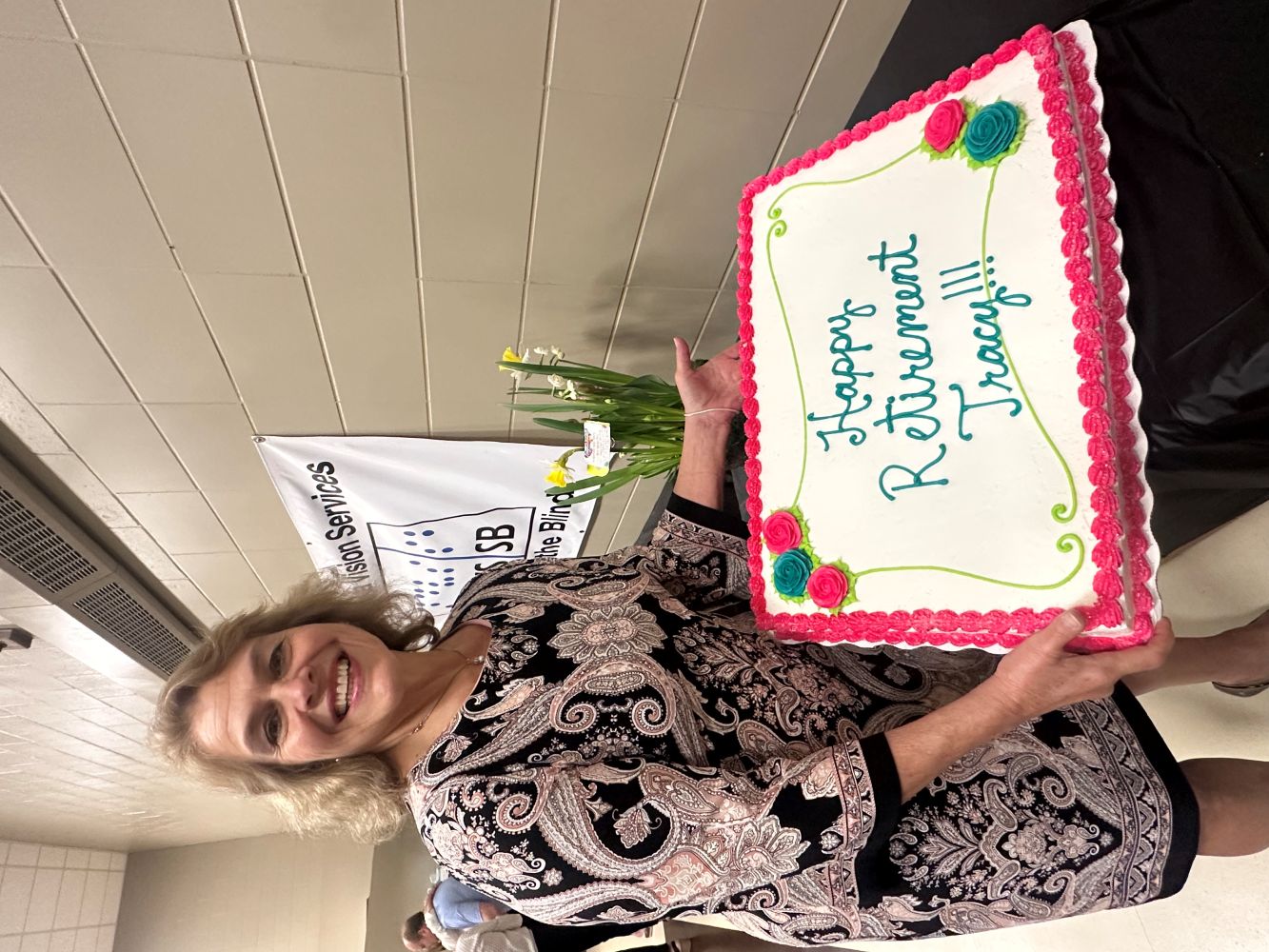 of the Visually Impaired, I am retiring and becoming, what is stated by Gemini on the computer as a “Seenager,” which is a popular blend of "senior" and "teenager"—describing someone who has money, can sleep in, and has zero parental supervision. It sounds great, doesn’t it! I will now go down memory lane a bit.
I started working for Services for the Visually Impaired back in 1985. At the time, it was a prevocational program through the Office of Vocational Rehabilitation for adults in North Dakota with vision loss. There were four staff people in that office: an administrator, an administrative assistant, an Orientation and Mobility Instructor, and me, as the Communications Instructor. I taught braille reading and writing, typing, handwriting, labelling, and money identification. Technology for the blind was in its infancy, and computers were the size of large pieces of furniture or bigger! People with vision loss came to Grand Forks from all across North Dakota for this training and would stay in Grand Forks for 10-12 weeks. I loved the work I was doing there. I was helping people, and I met many people who I am still in contact with today.
Categories: All News Items, Employee Spotlight, Student Programming
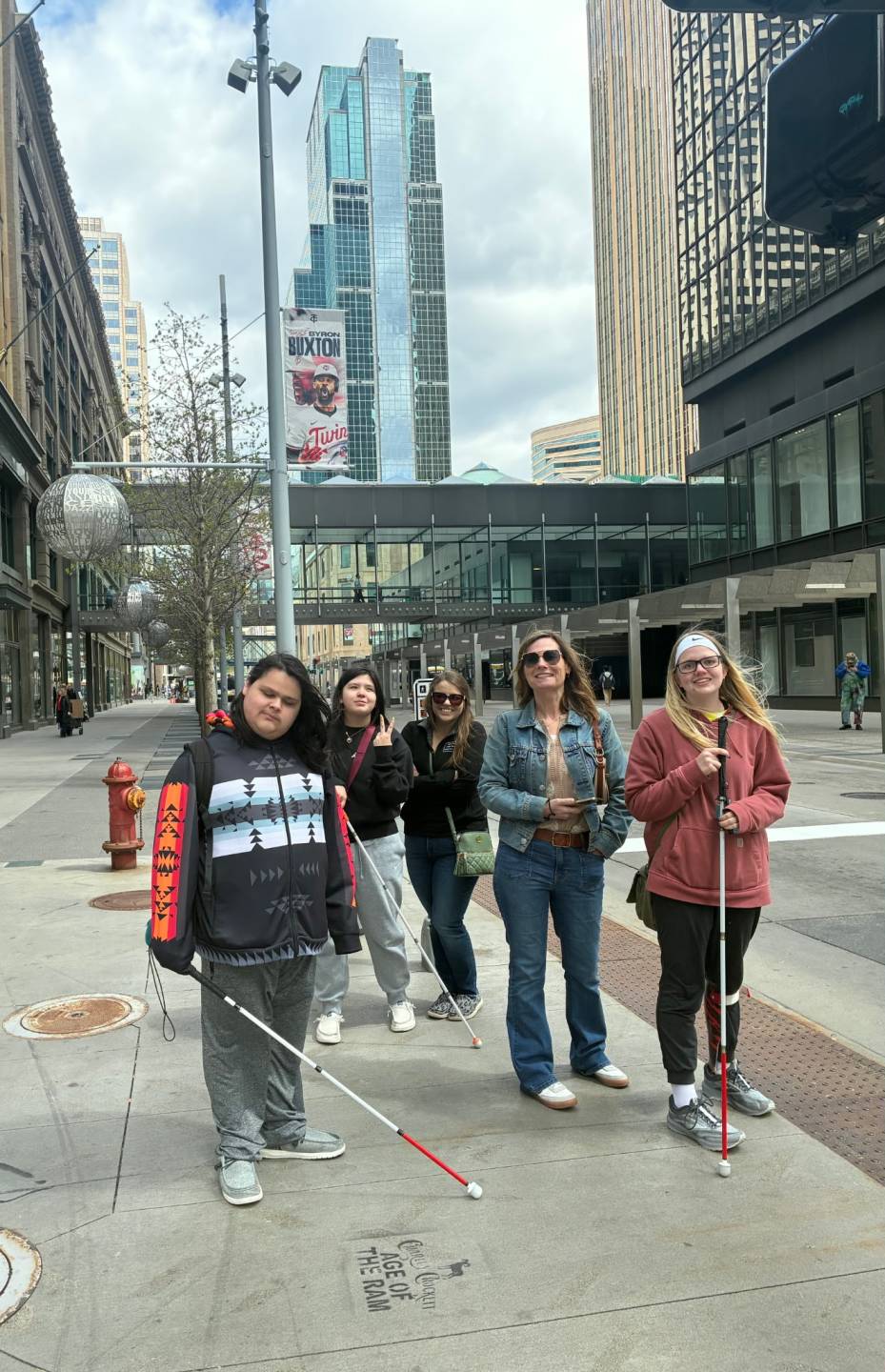 Our new Transition Specialist is a familiar face! Lilly Dunrud became our Transition Specialist in December. Read about her new role below.
I started working at NDVS/SB in December of 2018 as the APH Coordinator/ Administrative Assistant. In December 2025, I was hired as the Transition Specialist, which truly has been a dream come true. Having worked here for so many years, I feel that knowing the ins and outs of the agency has made this transition into my new role so much smoother.
As the new Transition Specialist at NDVS/SB, I am excited to continue building my knowledge and skills so I can best support students who are blind or have low vision as they prepare for life after high school. My goal is to help students build confidence, independence, and self-advocacy skills while exploring career interests, post-secondary education, employment opportunities, independent living skills, and community involvement. I look forward to helping students and families navigate transition planning, connect with resources, and develop the tools they need to successfully reach their personal goals.
Categories: All News Items, Adult Programming News, Spotlight
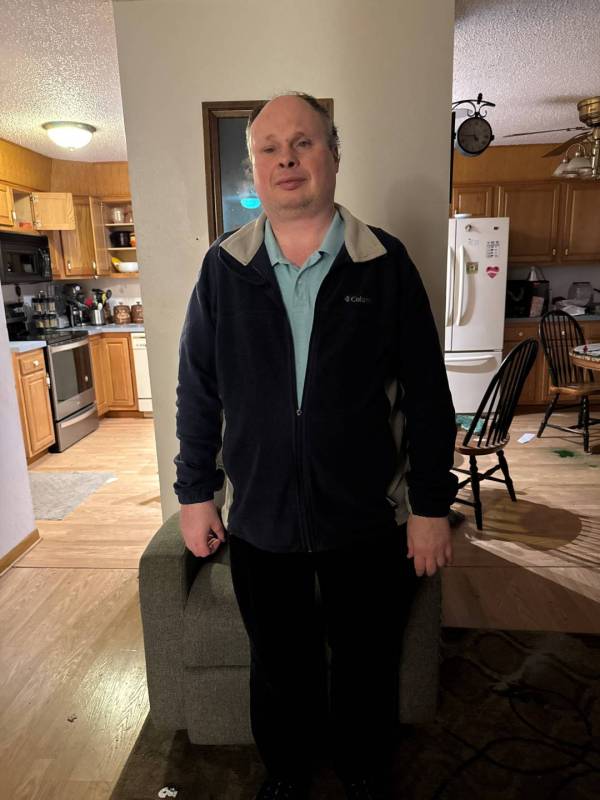 There are plenty of stereotypes regarding people who are blind, most of them negative. Even though people who are blind or have low vision prove these stereotypes wrong by simply living normal lives - succeeding in their jobs, raising families, and living independently, the stereotypes persist.
Jeremy Schmidt of Bismarck is one of those people proving the stereotype wrong. Jeremy has been blind his entire life, but – perhaps surprising to some people - graduated from college, has a successful career working as a Contact Service Representative for Social Security, is raising a family, and continues to grow and challenge himself. He is, you could say, living a normal life, where blindness can be a challenge at times but does not define his life.
Categories: All News Items, Adult Programming News, Spotlight
 The first time Chawnteeka Cooper attended an adult program at NDVS/SB, about 15 years ago, she was nervous. But the staff and instructors quickly made her feel comfortable. “They are all so encouraging,” Chawnteeka says. Over the years, she’s worked on cleaning techniques, cooking, braille, and technology skills during the weeks she’s attended adult programs and when NDVS/SB staff have visited her home. After she had her daughter, certified Orientation & Mobility Specialist Paul Olson, who also serves as Superintendent of NDVS/SB, taught her how to use her white cane while pushing a stroller. Now, she has a new goal – to get a guide dog. But that is no small feat. “I’m working hard to get my dog,” she says. “I have to pass a test to get one,” and Orientation & Mobility Specialist Margo Lentz is helping her learn what she needs to accomplish that goal. “I feel safe with her,” Chawnteeka says of Margo. “I know she’d jump in front of a car for me, for any of her students.”
Categories: All News Items, Employee Spotlight
NDVS/SB Data Administrative Assistant
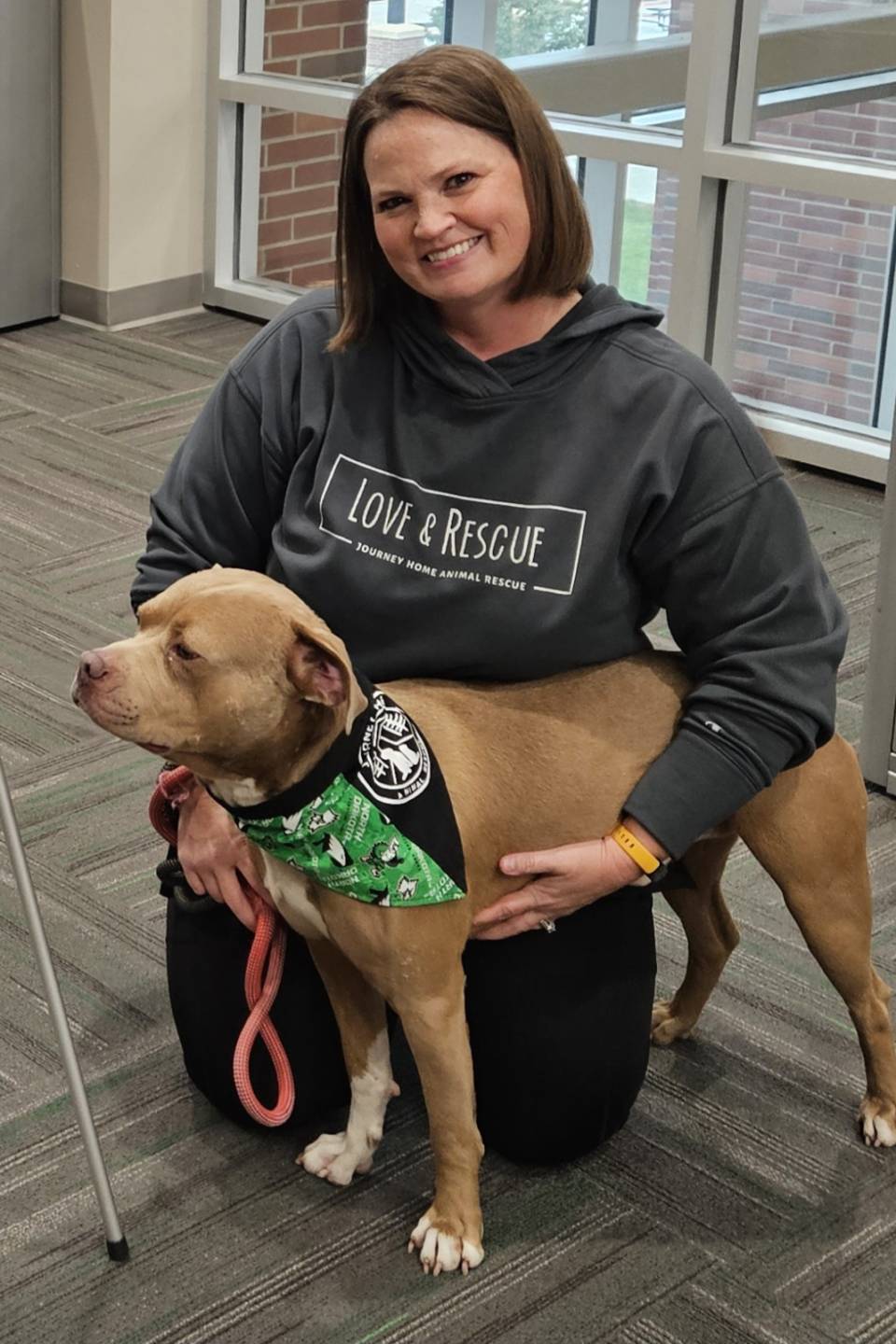
Amy Bohlman has suddenly found more time in her day. After 10 years of commuting from her home in Hatton, ND, to work in Fargo, the hour-plus drive – each way – is something she doesn’t miss. Her drive to 500 Stanford Road is a lot shorter. But she does occasionally miss her companions from some of those drives. “Transporting animals for the rescue was one thing that made commuting to Fargo bearable,” she says. Amy is a volunteer for Journey Home Animal Rescue, which finds foster homes and forever homes for strays and surrendered animals across the region. With her long commute, she was able to bring many animals to their new home. “Over several years, hundreds of passengers, and thousands of miles, I’ve met plenty of great animals and selfless volunteers,” she says. Less time in the car may mean less furry passengers, but it does give her more time for other volunteer tasks with the organization, and more time for her hobbies. Learn more about Amy by reading her answers below.
Categories: All News Items, Spotlight
With the Olympic games underway this month, and the Paralympic Games coming up, we have been thinking about what it takes to be an Olympian or a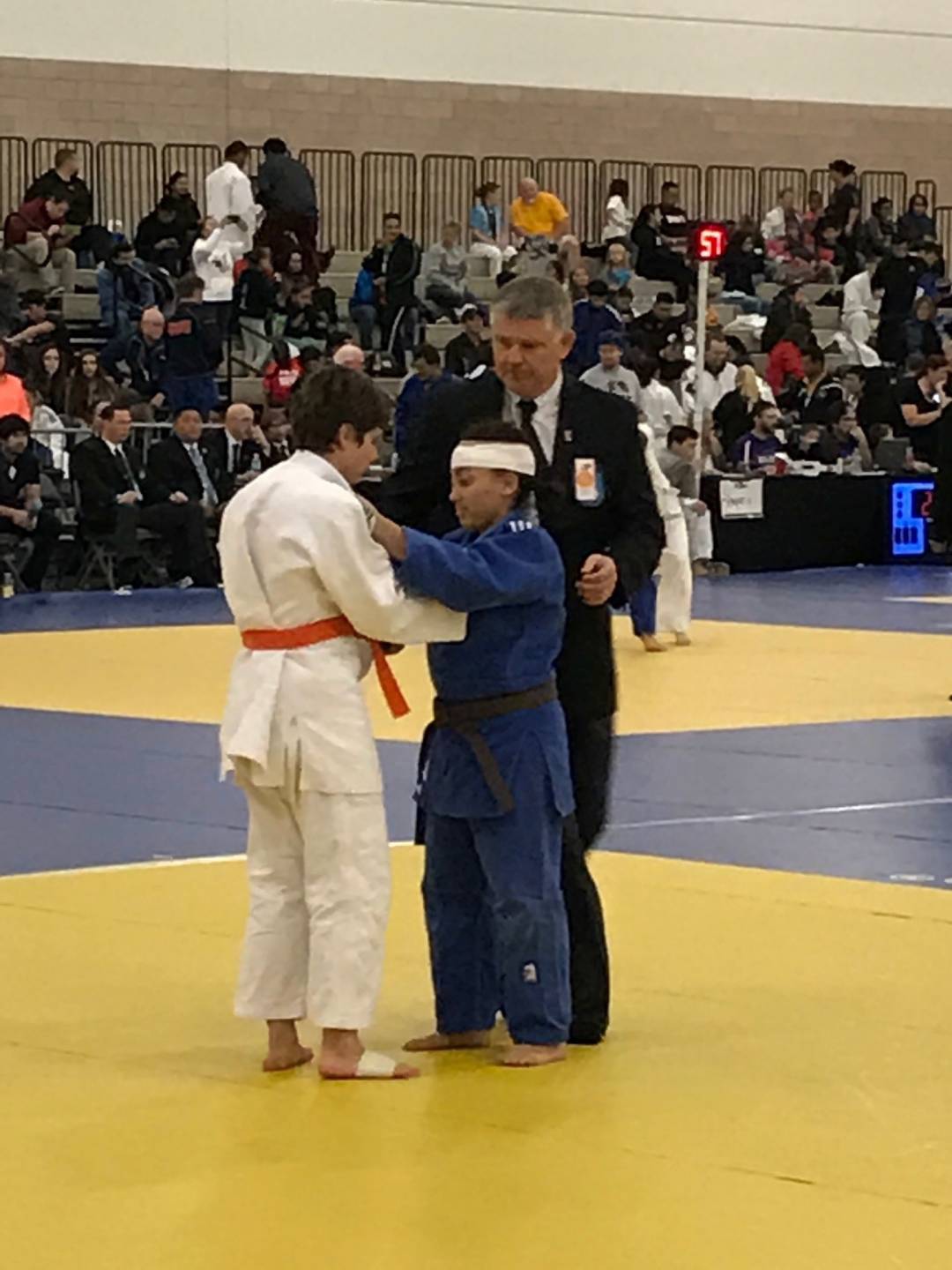 Paralympian. So why not ask the athletes themselves? Quincie Mattick, who spent much of her school years in North Dakota, was a member of the Paralympic Judo team, and made a run to compete at the Paralympics. While she ultimately decided to leave the sport before competing at the Paralympics, she learned a lot from her experience on the world stage. Read about her experience and the lessons it taught her, as well as her advice for young athletes today.
Categories: All News Items
by Paul Olson, NDVS/SB Superintendent
In an attempt to share some highlights of the year, here are my Top 10 Takeaways from 2025.
1. The staff at NDVS/SB are dedicated, fun, smart, hardworking and lots of other really awesome, cool and accurate adjectives.
2. We served a whopping 534 students and adults throughout the last biennium. Woo-Hoo!
3. We had another successful legislative budget proposal leading to an appropriation to carry out our mission to serve the great citizens of North Dakota for the next 2 years.
Categories: All News Items, Instruction, Student Programming
by Cindy Williams, TSVI and Coordinator of Student Programs
Greetings all!
Each year at this time, in my role as Coordinator of Student Programs, I reflect on and summarize the learning and educational experiences offered through our student short-term programs. This year, I am doing something a little different. Instead, I am writing about who we are and what we do as it relates to both our short-term programs and outreach services. This topic came to mind after receiving an email from the Council of Schools & Services for the Blind national listserv asking: How are services provided by schools or agencies that offer short-term programs along with outreach services? I realized this is likely a question shared by parents, educators, and even individuals we already serve. So, here we go—how do we incorporate student short-term programs with outreach services?
First, I would like to reiterate our mission, which was updated this past fall:
To provide specialized and individualized services for people of all ages who are blind or have low vision by partnering with families, educators, and agencies to empower them in achieving their goals.